Bridging Brilliance:
Engineering the Hudson
A twelve-week middle school engineering program where students design, model, build, test, and present a sustainable bridge across the Hudson River. Standards-aligned, industry-grounded, built for the inflection point where STEM identity is made.
A program designed like real engineering work.
Aedifica designs rigorous, project-based STEM programs that prepare middle and high school students for the real work of engineering, infrastructure, and the built environment. Bridging Brilliance: Engineering the Hudson is one example of how we do it.
In this twelve-week program, students step into the role of junior engineers tasked with designing a sustainable bridge across the Hudson River. They define the problem, study the typologies, model their solution digitally, build a physical prototype, test it under load, analyze their data, and present their final design to a public audience. By Week 12, every student has produced an engineering portfolio, contributed to a tested prototype, and delivered a public-facing presentation defended with evidence.
This page is a complete sample curriculum, shared as evidence of how Aedifica builds programs across grade bands. Schools and districts use this page to evaluate whether the program meets their academic standards, fits their schedule, and serves their students.
Full program spec.
Eight ways students learn like engineers.
Every week, students work the way professional engineering teams work: through structured collaboration, evidence-based decisions, and iterative design.
Authentic engineering practice
Students work through a complete engineering design cycle: define, model, build, test, refine, present. The cycle is not simulated; it is the same logic professional engineering teams use to deliver real infrastructure projects. Every decision is documented in an engineering notebook maintained from Week 1 through Week 12.
Hands-on prototyping
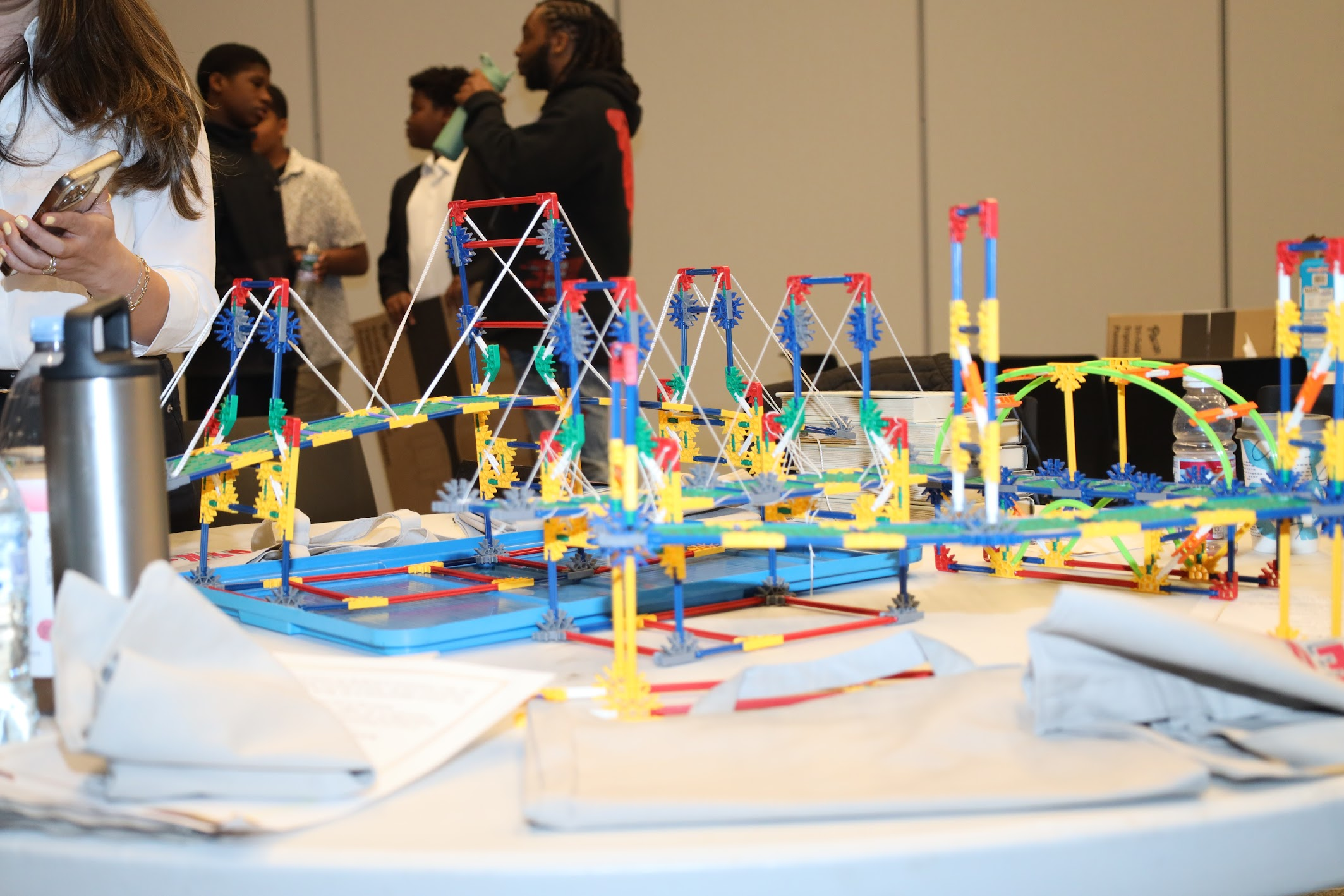
Students build physical bridge prototypes from K'Nex, balsa, or comparable construction systems. Each prototype is constructed under named constraints and then load-tested to failure on a calibrated rig. Students document failure modes, complete at least one redesign, and re-test.
Digital modeling and visualization
Students develop scaled digital models using Tinkercad, SketchUp, or Minecraft Education Edition. They produce scaled drawings on graph paper before building digitally, and calculate span, deck area, tower height, and cable length using proportional reasoning.
Real-world community context
The Hudson River setting is not decorative. Students investigate the geographic, demographic, and environmental conditions of the actual crossing they are designing. They map stakeholders, analyze emissions and habitat impacts, and write a problem statement that names whose lives their bridge will affect and how.
Structured engineering teams
Students operate in defined engineering roles (project manager, structural designer, data analyst, communications lead) that rotate across units so every student practices every function. Teams hold weekly stand-ups, conduct internal design critiques, and meet documented role accountabilities.
Studio-style lessons
The program runs as a studio: short science, math, and ELA mini-lessons followed by extended time to design, build, test, and revise. Direct instruction exists to serve the build, not the other way around, so every concept lands inside work students already own.
Universal Design for Learning
Graphic organizers, sentence frames, multilingual supports, vocabulary banks, and varied product options keep every middle-school learner engaged and supported. Students show what they know through drawings, models, data, and writing, not through a single assessment format.
Public showcase and defense
The program closes with a Final Bridge Showcase and Testing Competition. Teams present to a public audience of peers, families, educators, and STEM professionals. They defend their decisions with data, justify their trade-offs, and respond to audience questions.
What students can do by Week 12.
Aedifica defines outcomes in terms of what students can demonstrate, not what was covered. Each outcome maps to a specific assessment artifact.
Define an engineering problem. Students identify criteria, constraints, stakeholders, environmental considerations, and community needs for a real infrastructure scenario, and articulate them in a written problem statement.
Compare engineering solutions. Students explain how beam, arch, truss, suspension, and cable-stayed bridges differ in structure, geometry, force distribution, and material requirements, and justify which typology fits their site.
Apply quantitative reasoning. Students use ratios, scaled drawings, proportional reasoning, geometry, and unit-cost calculations to support every major design decision.
Develop digital and physical models. Students produce scaled sketches, build digital models in a CAD-class tool, and construct physical prototypes that meet defined performance criteria.
Conduct fair tests and analyze data. Students design and run load tests, collect performance data, document failure modes, graph results, and use evidence to drive design improvements.
Evaluate trade-offs systematically. Students compare design options using decision matrices that weigh cost, strength, sustainability, social impact, and risk, and defend their final choice with documented reasoning.
Write technical arguments. Students write engineering memos, design rationales, and a final design report that defend a claim with evidence drawn from research, calculations, and testing.
Collaborate in structured roles. Students practice professional team behavior including leadership, time management, peer feedback, role accountability, and structured critique, and reflect on their growth as collaborators.
Present and defend their work publicly. Students deliver a team presentation with slides, visuals, data displays, and clear oral communication to a non-classroom audience.
Connect engineering to identity and future. Students reflect on their growth as STEM learners and articulate how their work connects to high school STEM pathways, college options, and career possibilities in engineering, construction management, and the built environment.
Twelve weeks, three units, one capstone.
Each unit builds on the last. Click into any unit to see the week-by-week design, guiding questions, and student products.
Bridging Brilliance 2025
Rigorous alignment, plainly explained.
Bridging Brilliance is aligned with five standards frameworks, with more than forty aligned standards across the twelve weeks. Codes follow the NJSLS 2023 revisions for grades 7–8 and the Next Generation Science Standards engineering-design expectations. The full crosswalk with specific standard codes is available on request for curriculum coordinators and grant writers.
NGSS / NJSLS-Science: Engineering design
The program is built on the middle school engineering design strand (MS-ETS1-1 through MS-ETS1-4): define criteria and constraints of a design problem, evaluate competing design solutions systematically, analyze test data to identify the best characteristics, and develop a model for iterative testing and modification. Earth science extensions (MS-ESS3-3/5) appear in the sustainability content; physical science extensions (MS-PS2) appear in the forces and load-path work in Unit 2.
Full NGSS / NJSLS-Science crosswalk available on request.
NJSLS-Mathematics (Grades 7–8)
Scale drawings, unit rates, and efficiency metrics (7.RP.A.1–3); multi-step calculations in cost and constraints (7.EE.3–4); geometry of trusses, scale, and similarity (7.G and 8.G); probability, risk, and comparing test data (7.SP); with the Standards for Mathematical Practice (MP1–MP6) applied throughout.
Full NJSLS-Mathematics crosswalk available on request.
NJSLS-English Language Arts (Grades 7–8)
Argument writing to defend the best design (W.AW.7.1); informative and explanatory technical writing (W.IW.7.2); short research with gathered and cited evidence (W.RW.7.7, W.SE.7.6); evaluating arguments on infrastructure and justice (RI.AA, RI.CT); collaborative discussion and data interpretation (SL.PE.7.1, SL.II.7.2); and presenting findings with multimedia (SL.PI.7.4, SL.UM.7.5).
Full NJSLS-ELA crosswalk available on request.
Design, Technology & CS (NJSLS 8.1 / 8.2)
Applying the engineering design process (8.2.8.ED.1–7); technology's effect on people and the environment (8.2.8.ITH, NT); ethics, environment, and effects of technology (8.2.8.ETW); and data and analysis with computational tools (8.1.8.DA).
Full Design, Technology & CS crosswalk available on request.
Career Readiness (NJSLS 9.2 / 9.4)
Career awareness, exploration, and planning (9.2.8.CAP); creativity and innovation (9.4.8.CI); critical thinking and problem solving (9.4.8.CT); information and media literacy (9.4.8.IML); and technology literacy (9.4.8.TL), embedded throughout the twelve weeks.
Full Career Readiness crosswalk available on request.
The full standards crosswalk, assessment rubrics, and instructor guide are available on request. Contact Aedifica to receive any document directly.
Contact us for documentationEvidence schools and funders can show.
Assessment is built in from Week 1, not added in Week 12. Aedifica programs produce visible, structured evidence of student growth usable in parent communications, board reports, accreditation reviews, and grant applications.
What students produce
Engineering Portfolio
Every student maintains an engineering portfolio from Week 1 to Week 12. The portfolio includes their problem statement, criteria and constraints, sketches, scaled drawings, digital model output, cost calculations, impact analyses, risk matrix, testing data, and design reflections. The portfolio is the primary artifact for assessment.
Prototype and Testing Performance
Each team's physical bridge prototype is load-tested under controlled, repeatable conditions. Performance is documented with maximum load, deflection, cost-efficiency, and failure-mode analysis. Documented evidence of redesign and iteration is required; a prototype that performs well without showing iteration receives a lower score than one that demonstrates engineering improvement.
Presentation and Written Argument
Each team delivers a public presentation and submits a written design report. Both are assessed against a published rubric covering technical accuracy, evidence quality, sustainability reasoning, visual communication, oral communication, and response to audience questions.
Individual Reflection
Every student writes an individual reflection at the close of the program covering their growth in engineering thinking, mathematical modeling, collaboration, communication, and STEM identity. The reflection captures what each student now believes they are capable of, and what they want to do next.
What programs produce
Aedifica also collects program-level evaluation data that schools and districts can use in board reports, accreditation submissions, and grant applications. The data is reported back in a structured end-of-program report.
- Rubric scores. Engineering Design and Prototype rubric, Math and Quantitative Analysis rubric, Communication rubric, each scored across the design cycle and at the final showcase.
- Pre- and post-content assessments. Short content assessments aligned with MS-ETS1 and targeted math standards administered in Week 1 and Week 12 to measure growth.
- Participation and engagement. Attendance records, milestone-completion records, collaboration observation notes, and classroom participation logs.
- Student surveys and reflections. STEM interest, confidence, and identity surveys administered pre- and post-program, plus written reflections from every student.
- Artifacts and observations. Engineering notebooks, prototypes, presentation recordings, and structured classroom observation notes documenting implementation quality.
The end-of-program report is delivered to the school within 30 days of program close, in a format suitable for direct inclusion in board materials, district reports, or funder communications.
Middle school is where STEM identity is made.
Middle school is where students decide whether STEM is for them. By Grade 8, the students who will enter high school engineering, computer science, and applied science pathways have largely self-selected. Students who have not yet seen themselves as engineers, scientists, or technologists by that point face an increasingly narrow path to those identities later.
Bridging Brilliance is designed for that inflection point. It gives students three months of substantive engineering work: real problems, real prototypes, real data, real audiences, at exactly the moment they are forming their long-term sense of what they can become.
The program is also a model. It demonstrates how Aedifica designs STEM programs across grade bands and subject areas: rigorous, project-based, standards-aligned, hands-on, and built around real-world challenges that matter to the communities students live in.
From the instructor
Lessons from HIA Bridging Brilliance.
Dr. Karim Karam · Teaching Associate Professor, Civil, Environmental, and Ocean Engineering · Stevens Institute of Technology
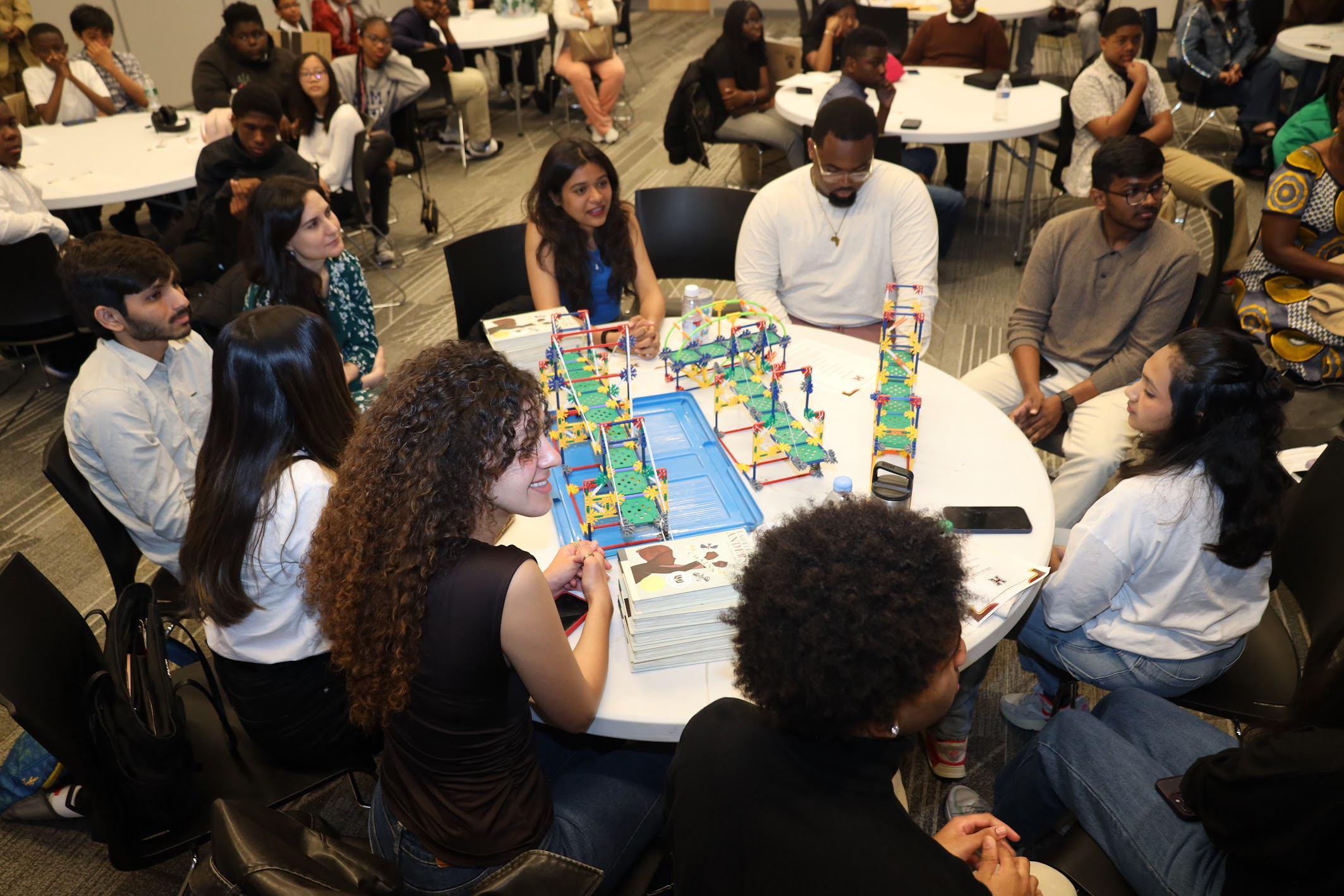
When we launched this year's HIA Bridging Brilliance program, we knew we were designing more than a STEM enrichment experience. We were building a bridge between middle school and high school, between curiosity and confidence, between Hillside and Hoboken, and between students' current sense of what is possible and the much wider horizon that engineering can offer.
"Strong programs are built on more than content. They depend on relationships, trust, institutional commitment, team chemistry, and a shared belief that middle school students are capable of far more than they are often asked to demonstrate."
Dr. Karim Karam
Bridging Brilliance 2025
Bring Aedifica programs to your students.
Aedifica designs STEM programs in partnership with schools, districts, enrichment providers, and community partners. Bridging Brilliance is one example of what we can build for your students.
Developed and delivered in partnership with the Hillside Innovation Academy.
Start a conversation